
AI Agents Shopping For Consumers: The Implications
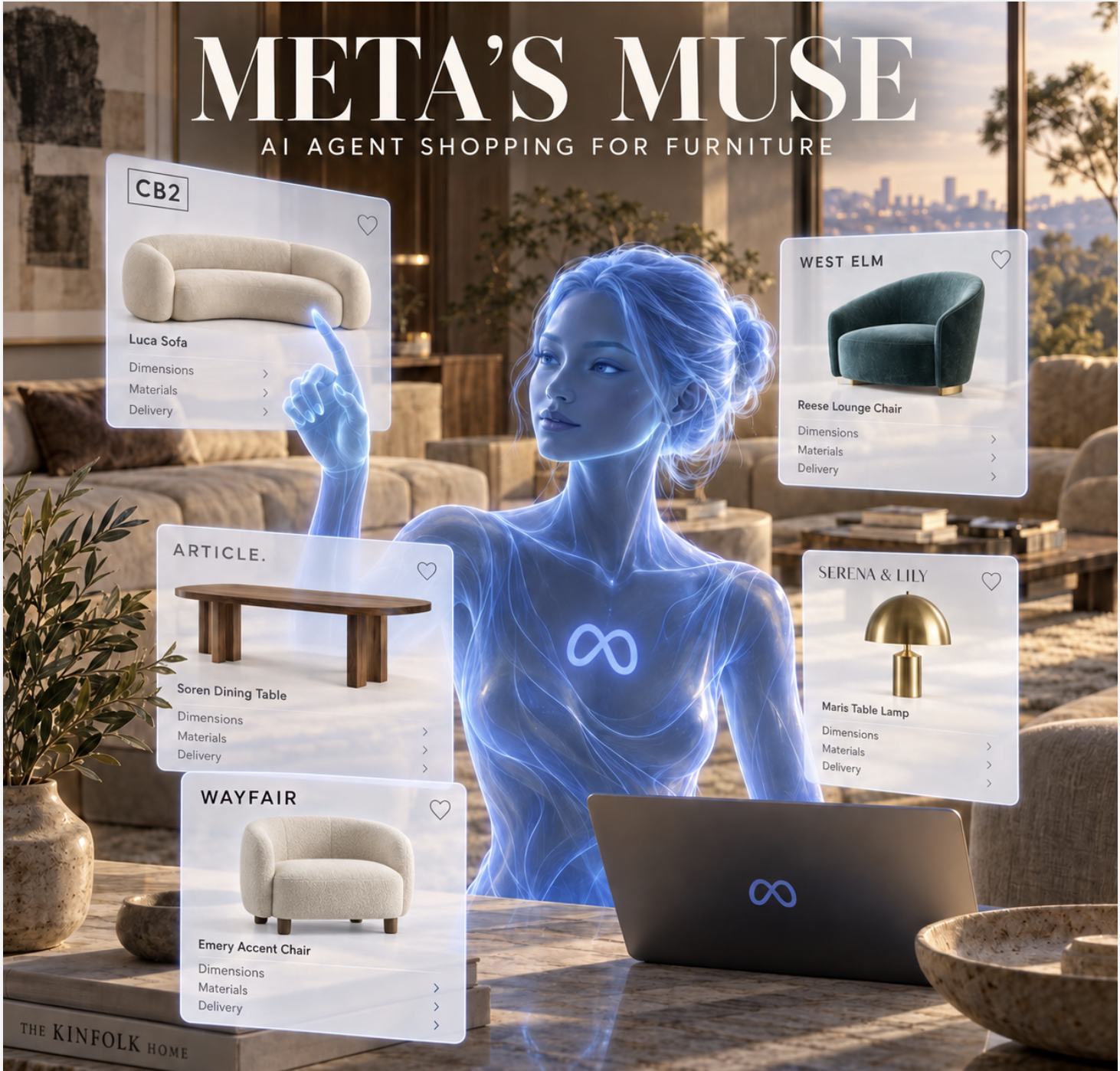
Meta recently introduced MUSE, its AI agent, that lets consumers use it for a variety of tasks, including shopping. It is quickly catching on with consumers who are using it to save time.
This has major implications for every business in the furniture, kitchen and bath, lighting, home decor and interior design industries that has an ecommerce site as part of their business, and, indeed, for every business with an ecommerce site.
The biggest risk is losing influence over why your customers or clients choose your product, and having your products judged mainly on specifications, price and delivery.
When MUSE becomes your customer’s primary shopping advisor, this is a problem.
Amazon recently banned MUSE from shopping its site, since Amazon is currently testing its own AI agent, Buy For Me, that will let customers shop its site and other sites using their Amazon Shopping app to complete purchases from other brand’s retailer websites if Amazon doesn’t sell the item directly.
Ecommerce retailers and designers selling widely distributed brands are particularly exposed. Your company’s sourcing expertise, service, and problem resolution may receive little weight from MUSE unless the customer who is shopping requests information about these areas and your site clearly communicates their value.
The chance for costly buying mistakes is increased as most customers who are using MUSE’s AI agent don’t know to ask for all the variables they should be asking for when it comes to furniture, lighting, kitchen and bath appliances and cabinetry, etc. This could lead to expanded returns on merchandise.
It’s also a problem when consumers rely on an AI agent’s shortlist. Being excluded from that shortlist means losing consideration by your customer before your sales process begins. There’s no opportunity to upsell or explain or listen or show empathy or to share design advice.
Small ecommerce sites could be at a disadvantage when larger competitors provide more complete, current, and easily interpreted product information.
If you’re an interior designer or kitchen and bath designer reading this post, considering whether or not to open an ecommerce site in 2027, I would advise against it. It’s going to be very expensive and time consuming to compete with larger ecommerce sites with larger budgets who are working diligently to capture the traffic from AI agent searches.
My advice? Consider taking that investment and opening a small brick and mortar storefront, instead. People are hungry for places to go that inspire them and give them a reason to get out of the house and off their phones.
SOLUTIONS FOR ECOMMERCE RETAILERS NOW:
Right now, all ecommerce retailers need to act on this if they want to be found by AI agents shopping on behalf of consumers:
1. Put your expertise directly on every product page
Tell your customers why you selected a particular item.
Share a detailed description about what space the item suits and why. Think like the person searching with MUSE. What would that customer be looking to find out?
Share all the construction details that justify the price.
Share important limitations or situations where you would recommend something else.
Share specific, substantiated information [reviews, testimonials, articles about a particular item] making your judgment more useful to both people and agents.
2. Make product information complete and machine-readable.
Start with your 20 most important products. Include dimensions, materials, finish options, exact variants, current prices, availability, delivery services, and return restrictions in readable text—not solely in images or PDFs.
Ask your website provider to check product structured data, the behind-the-scenes labels that help systems interpret those details. Google supports product, shipping, and return information through this format; but even that does not guarantee Muse placement.
If you use Shopify, review its agentic storefront settings and catalog information before buying additional software. Shopify provides tools for distributing product information to AI channels and controlling that access.
3. Build a human checkpoint into expensive or complicated orders.
Keep straightforward purchases simple. For custom upholstery, sectionals, made-to-order furniture, or difficult deliveries, require confirmation of the relevant details before the order enters production.
Use a clear order summary covering configuration, fabric, dimensions, access requirements, delivery scope, and cancellation terms. Make this an actual ordering step: a sentence saying “please check measurements” is much easier to overlook.
I hope this post has been helpful to those of you with ecommerce sites in understanding what you need to do right now in order to be prepared for MUSE’s AI agents as well as Amazon’s Buy For Me AI agents, too, shopping on behalf of consumers, especially during the upcoming holiday season.
Leslie Carothers
Savour Partnership
Named One of The Top 40 Most Inspiring Women In Home
LinkedIn | Instagram